Should you stay
in Gion?
Stay in Gion only if you will actually use it. The whole argument for sleeping here is two hours nobody else gets: Kiyomizu-dera at its 6:00 opening, a ten-minute walk uphill, and Hanamikoji after 19:00 when the day-trippers have gone and the lanterns are lit for about forty people. Between 10:00 and 17:00 this is the most crowded district in Kyoto and your expensive room is worth nothing. Mid-range runs $250–450 a night, the flagships $800–2,000+. Budget travellers and anyone who wants a bar after 23:00 should sleep downtown, 12 minutes' walk west.
Who Gion is for, and who should avoid it
Gion is worth its premium for one reason: you can be at Kiyomizu-dera at 6:00 and back on Hanamikoji at 21:00 without touching a train. If you will not do either, you are paying roughly ¥15,000 a night extra for a bed you only sleep in.
Stay here if you are a couple or on a honeymoon, you take photographs seriously, you are on a second trip and have already ticked off the greatest hits, or you specifically want one of the flagship hotels that landed here between 2020 and 2026. It also suits anyone whose idea of a good evening is a quiet stone lane and a kaiseki counter rather than a bar.
Avoid it if you are travelling on a budget — this is the most expensive district in Kyoto and rooms under $150 barely exist. Avoid it if you want nightlife: the temple half shuts between 17:00 and 18:00, the Kiyomizu approach is dead by 19:00, and every bar you are imagining is actually across the river in Kiyamachi and Pontocho. Avoid it with small children or heavy suitcases, because the good half is stone slopes and steps.
The geography matters more than the name on the booking page. Gion proper — Hanamikoji, the Shirakawa canal, Yasaka Shrine — sits flat beside the Kamo River, two minutes from Gion-Shijo station. The Kiyomizu side climbs: Ninenzaka, Sannenzaka and the temple are a 20-minute uphill walk from that same station, or a bus. A hotel advertised as "Gion" can be either. Open a map before you pay.
If the premium looks hard to justify, it usually is. Read the head-to-head at Gion vs Downtown, or compare every district on the where to stay hub.
What to do in Gion and Southern Higashiyama
This is the densest square kilometre of sightseeing in Japan, and almost all of it is walkable from a Gion bed. The order below is the one that dodges the crowd.
Kiyomizu-dera, ¥500, opens at 6:00 — the single best crowd hack in the city, because every other headline sight opens at 8:30 or 9:00. You get the wooden veranda with a dozen people on it instead of a thousand. Full verdict on the Kiyomizu page.
Sannenzaka and Ninenzaka, the preserved stone lanes below the temple, are free and belong to you before 9:00. Shops open around 10:00, which is also when the lanes stop being photographable. Ishibei-koji, beside Kodai-ji, is the quietest and arguably the most beautiful of them.
Kennin-ji, ¥800, is Kyoto's oldest zen temple, sitting at the bottom of Hanamikoji and staying oddly uncrowded. Twin dragons on the ceiling, a circle-triangle-square garden, and photography is permitted, which is rare. Kodai-ji is ¥600 for a raked garden and a short crowd-free bamboo path. Yasaka Shrine is free, open 24 hours and lit all night; Maruyama Park behind it is the city's most famous cherry-blossom spot and a scrum in early April.
Hanamikoji at dusk and the Shirakawa canal are the free half of Gion. Shirakawa — a narrow waterway lined with weeping willows and ochaya balconies, one block north of Shijo — is prettier than Hanamikoji and takes a fraction of the traffic. Both are best after 19:00; see Kyoto at night for the rest of the evening.
Renting a kimono here is a genuinely good idea and costs ¥3,000–6,000 for the day — these lanes were built for it. Details on the kimono rental page.
What hour to walk Hanamikoji
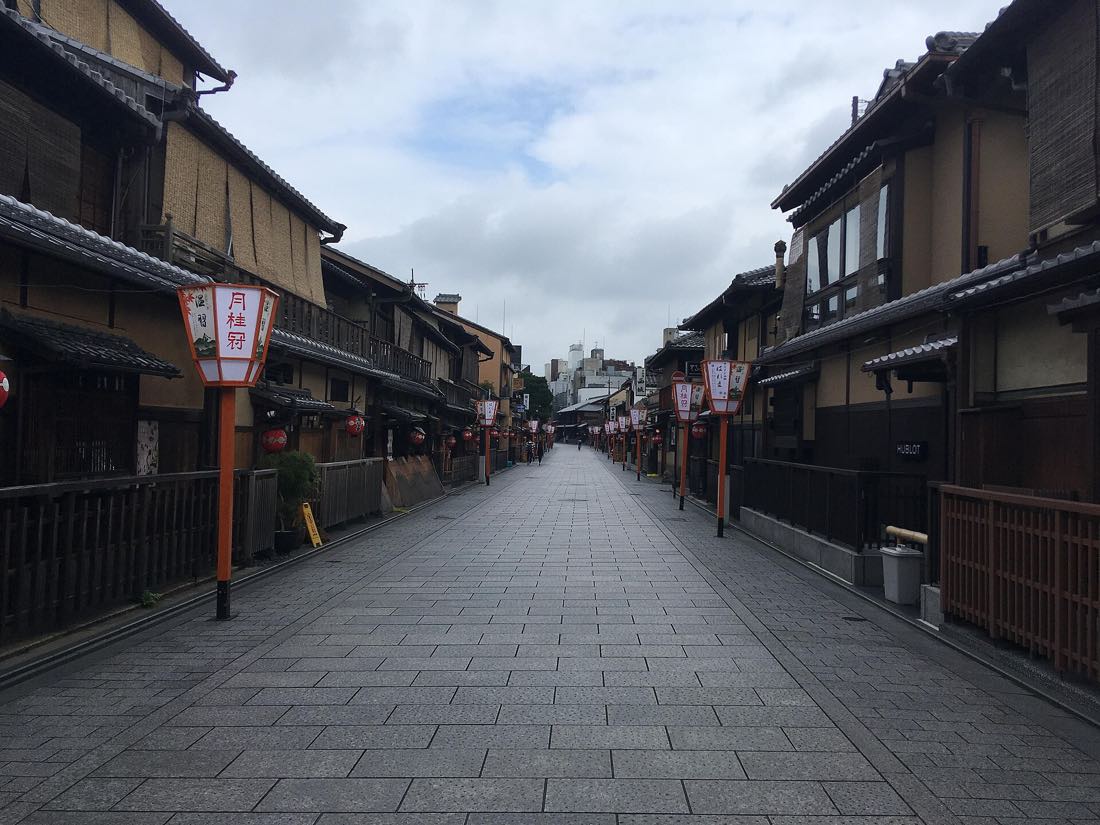
Hanamikoji is a public street with no gate and no closing time, which makes it purely a timing decision. The transformation between 17:00 and 20:00 is the most dramatic in Kyoto, and it is the entire reason to sleep here rather than visit.
The best trade-off: lit, atmospheric, and quiet enough to hear your own footsteps.
Gion etiquette — the parts that carry fines
Gion is a working residential and business district, not an attraction, and the rules below are enforced rather than aspirational. The signage is in English. Breaking them is the fastest way to become the tourist everyone in Kyoto complains about.
Since April 2024 the small private lanes running off Hanamikoji have been shut to tourists, with signposted penalties of up to ¥10,000. Those alleys are privately owned by the local district association, which is what makes the ban enforceable. If a lane has a barrier, a rope or a sign, it is not a shortcut — it is somebody's front door.
Up to ¥10,000A photography ban on the private streets has been in force since 2019, brought in after documented harassment — a torn kimono sleeve, a cigarette butt dropped into a collar, tourists grabbing at women on their way to work. Ask first, in any language, and accept no. A maiko walking quickly is on the clock and cannot stop.
Banned since 2019The behaviour locals report most is a crowd forming a corridor and walking backwards in front of a maiko. Stand aside, let her pass, and do not trail her to the next doorway. The same applies at ochaya entrances: those are workplaces with paying guests inside.
The 2024 closure was widely misreported as "Gion bans tourists". It did not. The main north–south run of Hanamikoji, Shijo-dori, Yasaka Shrine, the Shirakawa canal and every restaurant on them remain open to anyone. Walk the public street, stay off the private ones, and there is no problem.
Geiko and maiko move between engagements around 17:45, which is when small crowds gather at the Hanamikoji and Shijo corner. No tour can promise a sighting, and any operator who does is lying. Many of the "maiko" you will photograph at 14:00 are tourists in a ¥15,000 makeover package.
The paid experiences — a maiko dinner at ¥20,000–30,000, a Gion Corner show around ¥5,500 — are optional. The free versions: walk Hanamikoji and Shirakawa after 19:00, watch the public performances at Yasaka Shrine on festival dates, and sit in Kennin-ji's garden for ¥800. Yasaka Shrine itself costs nothing and never closes.
Where to eat in Gion
Gion is Kyoto's kaiseki heartland and the prices say so. The single most useful trick: eat the same kitchen's cooking at lunch for roughly half — mid-tier kaiseki lunch runs ¥7,000–10,000 against ¥20,000–30,000 at dinner.
Some of the old ochaya operate ichigen-san okotowari — no first-time customers without an introduction from an existing patron. This is real, it is not aimed at foreigners specifically, and it applies to a small number of teahouses rather than to restaurants generally. Anything with a menu in the window will seat you.
For a set-piece meal, book kaiseki two to eight weeks ahead through your hotel; Higashiyama concierges do this constantly and it works far better than emailing from abroad. Gion Hatanaka runs the best-known maiko dinner, a set evening with performance and conversation, and it is the honest way to meet a maiko rather than ambushing one on the street. See the kaiseki page for what you are actually paying for.
For an ordinary good dinner, walk. Ten to fifteen minutes west over Shijo bridge puts you in Pontocho, Kiyamachi and the Nishiki grid, where the same quality costs about a third less — see downtown. On the Gion side, the reliable cheaper options are the yakitori and obanzai counters on the side streets off Shijo.
Daytime: Kagizen Yoshifusa on Shijo has been making wagashi since the Edo period and serves kuzukiri in a tea room behind the shop for around ¥1,500. Matcha parlours cluster on the Kiyomizu approach at tourist prices — better options on the matcha page. Remember the approach street empties between 17:00 and 18:00, so eating up there means eating early.
Gion, practically
Where to sleep in Gion
Gion is where Kyoto's luxury hotel boom happened: Park Hyatt, Four Seasons, Banyan Tree, Six Senses, Capella (the brand's Japan debut, opened March 2026), Shinmonzen with its Tadao Ando concrete, and the Imperial Hotel Kyoto in the restored Yasaka Kaikan since spring 2025. Hotel Seiryu occupies a converted 1933 school. Below that tier, Celestine Gion is the sane mid-range pick and Gion Hatanaka is the ryokan people book for the maiko dinner.
Gion after dark, with someone who knows it
You never need a ticket to walk Gion. What a guide buys you is the right hour, the district's history, and someone to stop your group breaking a rule by accident. Temple gates take cash at the door and never sell out — a tour is worth paying for because of the guiding and the hour, not to skip a queue that does not exist.
The three alternatives, honestly
Most people who ask about staying in Gion should book somewhere else and walk in. Here is where.
Downtown is 12 minutes' walk away, costs $150–300 for the standard that runs $250–450 in Gion, and puts two subway lines and a thousand restaurants under your feet. The right answer for most first trips.
Northern Higashiyama keeps the temple-district calm without the Gion price or the Gion crowd, and gives you the best walking day in the city out of your front door. Far fewer beds, though.
The station area is where you save $100 a night and lose the evenings. Fine if your trip is day-trip heavy or you are bracketing a Shinkansen.
Still torn? Read Gion vs Downtown, and run the money on what Kyoto costs in 2026.
Staying in Gion FAQ
Is Gion worth staying in?
Only if you will use the early morning or the late evening. Gion's value is that Kiyomizu-dera opens at 6:00 a ten-minute walk uphill, and that Hanamikoji empties after 19:00. If you plan to leave at 9:30 and return at 18:00, you are paying $100–200 a night extra for nothing and downtown is the better book.
Can you take photos of geisha in Kyoto?
Not on the private streets, and not of any geiko or maiko without her consent — a ban has been in force since 2019 after documented harassment incidents. Photographing the public street, the buildings and the lanterns is entirely fine. If you want a portrait, book a maiko dinner or a Gion Corner performance, where photography is arranged.
Why is Gion so expensive?
Because seven or eight international luxury brands opened in the same district between 2020 and 2026 — Park Hyatt, Four Seasons, Banyan Tree, Six Senses, Capella, the Imperial Hotel Kyoto — and there is almost no land left to build cheap rooms on. Expect $250–450 mid-range and $800–2,000+ at the top, before the ¥400–¥10,000 lodging tax.
What time do the geisha come out in Gion?
Around 17:45, when geiko and maiko move between engagements — that is when small crowds gather at the Hanamikoji and Shijo corner. It is luck, not a schedule. Anyone in full kimono and white makeup posing happily for photographs at 14:00 is almost certainly a tourist in a ¥15,000 makeover package.
Is Gion a good place to stay with kids?
Not especially. The Kiyomizu half is stone slopes and steps, family rooms are rare and expensive, restaurants skew to counters and set menus, and the district shuts early. Downtown and the station area both work far better with children — see Kyoto with kids.
How far is Gion from Kyoto Station?
Bus 100 or 206 takes 15–20 minutes for a flat ¥230, a taxi is ¥1,000–1,500, and there is no direct subway. That gap matters if you are arriving with luggage or catching an early Shinkansen — the station area exists precisely to solve it.
Is there nightlife in Gion?
Barely. The teahouses are private, the temple approaches close between 17:00 and 18:00, and the streets are quiet by 22:00. Kyoto's actual nightlife is Kiyamachi and Pontocho, 12 minutes' walk west across Shijo bridge, and it runs until around 01:00.