Is Fushimi Inari
worth it?
Fushimi Inari is free, open 24 hours a day, and the best single thing to do in Kyoto — at the right hour. Between 9:00 and 17:00 the lower gates are a shuffling queue and the photograph you came for is impossible. Arrive before 7:00 or after 21:00 and you will have long stretches of the mountain to yourself. Budget two to three hours, walk as far as the Yotsutsuji intersection (30–40 minutes up, where the view actually opens), and skip the summit — it is tree-blocked and anticlimactic.
What hour to go
The shrine never closes, which makes it the most timing-sensitive sight in Kyoto. Crowd density drops by roughly 80–90% past the first rest stop at any hour — but the first 400 metres is where every photograph gets taken.
The best trade-off in Kyoto: daylight, stalls starting to open, near-empty gates. Go now.
What to expect at Fushimi Inari
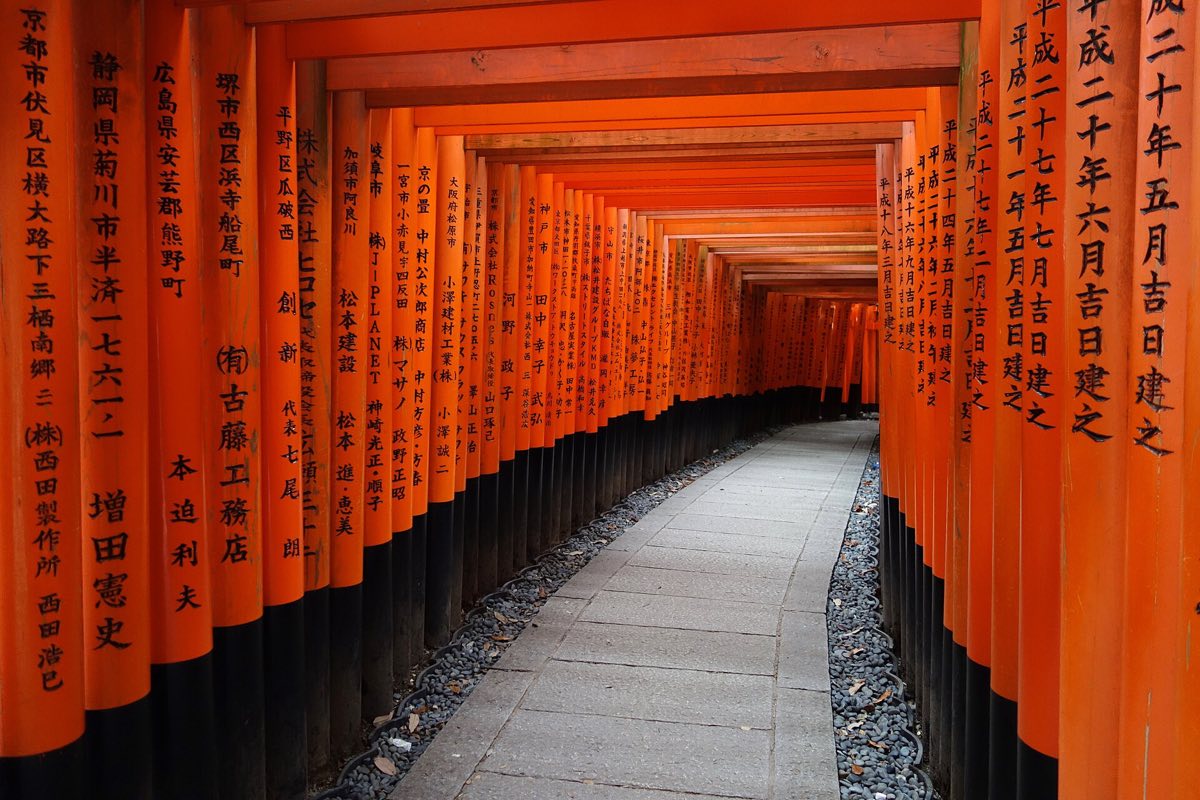
Roughly 10,000 vermillion torii gates line a 4km loop up a 233-metre mountain. Every gate was paid for by a business, and you can read the donor's name and the date on the back of each one as you climb.
The famous stretch, Senbon Torii ("thousand torii"), starts about 300 metres behind the main hall and splits into two parallel tunnels. This is the photograph. It is also only around 400 metres long, which is why pictures never convey how short the iconic section really is.
Past that, the crowd thins hard. At the Yotsutsuji intersection, 30–40 minutes up, you get the only real view over Kyoto on the mountain, a couple of teahouses, and about a tenth of the people who were with you at the bottom. Most travellers who came away loving Fushimi Inari turned around here.
The full summit loop takes another 45–60 minutes and rewards you with a small shrine and no view — the trees grew in decades ago. Do it for the walk and the hundreds of miniature torii and fox shrines along the way, not for a payoff at the top.
Food stalls along the approach street sell grilled quail, inari-zushi and taiyaki from about ¥400. They close around 17:00, so an evening visit means eating before or after.
Is Fushimi Inari for you?
The practical bit
Guided options worth paying for
The shrine is free and you never need a ticket. What you can buy is company at an hour you would not otherwise get up for, and someone to explain what the fox statues and gate inscriptions actually mean. Temple gates take cash at the door and never sell out — a tour is worth paying for because of the guiding and the hour, not to skip a queue that does not exist.
What to pair with Fushimi Inari
Fushimi Inari sits on the JR Nara Line, which makes the southern half-day the most efficient block in Kyoto.
Tofuku-ji is one stop back toward Kyoto Station (¥150). Its Tsutenkyo bridge over a maple valley is the most spectacular autumn sight in the city — and in late November, the most crowded. Off-season it is calm and costs ¥600.
Uji is twelve minutes further down the same line: Byodo-in's Phoenix Hall (the building on the ¥10 coin), tea shops roasting on the approach street, and the Nintendo Museum one stop away. See the Uji guide.
The Fushimi sake district is 3km south of the shrine at Chushojima — canals, warehouses, around 40 breweries, and almost no Western tourists. The Gekkeikan museum is ¥600 including a tasting.
Nara sits on the same axis if you want a full day instead: 45 minutes and ¥760 by Kintetsu express.
Fushimi Inari FAQ
What time should I get to Fushimi Inari?
Before 7:00 if you can manage it — you will have the Senbon Torii tunnel essentially to yourself and the light is good. The second-best window is after 21:00, when the gates are lit and you can walk ten minutes without seeing anybody. Turning up at 10:30 is the single most common Kyoto mistake.
Is Fushimi Inari safe at night?
Yes. The shrine is open 24 hours, the lower trail is lit, and locals walk it. Two practical warnings: the upper loop past Yotsutsuji has unlit stretches, so bring a phone light, and check the last JR train from Inari station — services run until roughly midnight.
How much does Fushimi Inari cost?
Nothing. There is no entry fee, no ticket and no gate, at any hour. Getting there costs ¥150 on the JR Nara Line from Kyoto Station, five minutes. Anyone selling a 'skip the line' ticket is selling something that does not exist.
How long does it take to walk the whole thing?
Two to three hours for the full summit loop at a normal pace — about 12,000 steps and a 233-metre climb. To Yotsutsuji and back, where the view is, takes 45 to 60 minutes. Most people who report disappointment walked only the first 400 metres at midday.
Do I need to climb to the summit?
No, and most Kyoto regulars advise against it. The summit shrine has no view — trees grew in decades ago. Yotsutsuji at 30–40 minutes is the real destination: the city opens up, there are teahouses, and the crowd has already thinned by around 80%.
Can I combine Fushimi Inari with Nara in one day?
Yes, and it is a natural route — both sit on lines running south from Kyoto Station. Do Fushimi Inari at 6:30, be back on a train by 9:00, and you are in Nara before the deer park fills. Several bus tours package the two; compare them on the day trips hub.
Is Fushimi Inari good in the rain?
Better than most Kyoto sights. The torii tunnels are effectively covered, the crowds halve, and wet vermillion photographs beautifully. The stone steps get slippery, so wear something with grip.