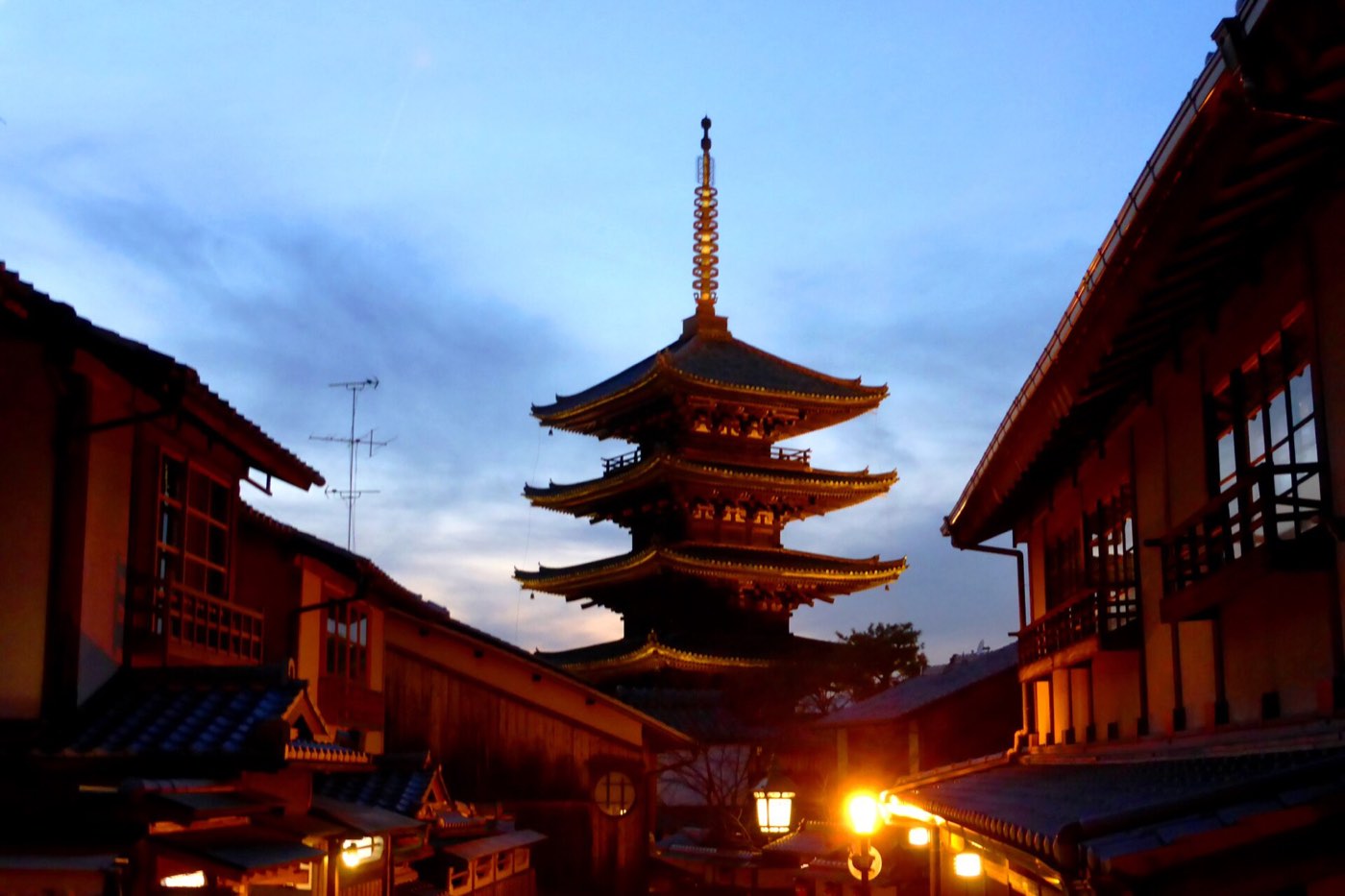
Kyoto in
one day
One day in Kyoto is a real trip if you treat 06:15 to 09:00 as non-negotiable and stay on one side of the Kamo River. Here is the route, stop by stop, with the trains and the fees.
One day works, and it works well: Fushimi Inari at 06:15, then Southern Higashiyama on foot, then Gion at dusk. What decides the day is where you slept. A bed in Kyoto buys the dawn gates and the 17:45 Gion window — the only two hours the famous places are not a queue. Day-tripping from Osaka puts you on the ground at 09:30 and back on a train by 18:00, which is precisely the eight hours everyone else is also here. Budget around ¥1,900 in entries and ¥600 in fares.
One day means one side of the city
Kyoto's big sights sit at opposite corners of a city 15km wide. In one day you pick one axis and walk it. Adding Kinkaku-ji or the bamboo grove to the route below costs you two hours on a bus and buys you nothing.
The default axis is south then east: Fushimi Inari at first light, back to Kyoto Station, then Kiyomizu-dera and the Higashiyama lanes, then Gion. Everything after the first train is walkable, which is why it survives a day with no slack in it.
The one ordering decision. Kiyomizu-dera opens at 6:00 — the best crowd hack in the city — and Fushimi Inari never closes. You can only be at one of them at dawn. The route below puts Fushimi Inari first because the light through the gates is better and because Kiyomizu at 09:15 is survivable, whereas Fushimi Inari at 09:15 is a shuffling line. If you would rather have Kiyomizu empty, flip it: Kiyomizu at its 6:00 opening, the lanes at 07:30, and Fushimi Inari from 18:00, when the trail lamps come on and the crowd has gone. Both versions work. Doing both at 10:00 does not.
Skip the buses entirely. Kyoto abolished the tourist bus day-pass in 2023 to push visitors onto rail, and the 205 at peak is the worst experience the city offers. On this route you take one train, walk, and take one taxi if your legs give out. Full breakdown on the transport page.
Dawn gates to lantern light, east side only
Fushimi Inari at first light
JR Nara Line from Kyoto Station to Inari — 5 minutes, ¥150, and the shrine is straight across the road. Free, open 24 hours, no ticket at any hour. Walk to the Yotsutsuji intersection, 30 to 40 minutes up, where the view over Kyoto opens and about 80% of the crowd has already turned back. Then come straight back down; the summit is tree-blocked and adds an hour for no payoff. See the full verdict.
Back to Kyoto Station, eat something
The train back is another 5 minutes and ¥150. Approach-street stalls at the shrine only start opening around 09:00, so eat at the station — the basement food halls and the Porta level open early and are genuinely good. If you are carrying luggage, dump it now: station coin lockers are reliably full by 10:00, so use a staffed bag drop instead.
Kiyomizu-dera — busy, and worth it anyway
¥500. Fifteen minutes by taxi from Kyoto Station, about ¥1,000–1,500, and worth every yen against a bus that takes 40 minutes and drops you at the bottom of the hill regardless. Be honest with yourself: by 09:15 the veranda is busy and the approach is shoulder-to-shoulder. The building still earns it — a 13-metre stage on wooden pillars assembled without nails, over a valley. The alternative is to flip the day and be here at the 6:00 opening instead, which is the best hour in Kyoto and costs you the dawn at Fushimi Inari. Full verdict here.
Sannenzaka and Ninenzaka downhill
The preserved stone lanes below the temple are the postcard, and they are free. Shops open around 10:00, so this is when they are worth walking rather than at dawn. It is 600 metres of slope, uneven stone and no shade — sandals and rolling luggage are both mistakes here.
Kodai-ji and Ishibei-koji
¥600, and the best-value 30 minutes on the route: a raked garden, a small bamboo path with nobody in it, and beside the temple the stone lane widely called the most beautiful in Kyoto. If you are running late, this is the stop to cut.
Lunch downtown, and a real sit-down
Cross the Kamo River at Shijo into downtown. The department-store restaurant floors at Takashimaya and Daimaru are the reliable no-reservation fallback and much better than that sounds. Take a full hour — you have already walked 8km, and the afternoon has the worst light and the worst crowds of the day.
Nishiki Market as a walk, not a meal
Five blocks of covered market, free to walk. Tour groups flood it around 11:30, so 14:00 is a decent window and after 15:00 is better. Two rules: eating while walking is discouraged, so eat at the stall you bought from, and treat it as a look rather than lunch — prices on the tourist-facing stalls have drifted. Is it a tourist trap now?
Rest, or one more temple
Go back to the room for an hour if you have one. If you would rather keep moving, Sanjusangendo is ¥600 with last entry at 16:30 — 1,001 gilded Kannon statues in a 120-metre hall, photography banned inside, which is exactly why it stays uncrowded and why it tops so many best-thing-we-did lists.
Gion at dusk — the second-best hour
This is the window when geiko and maiko move between engagements along Hanamikoji, and the reason a one-day trip should end here rather than at a station. The rules are not decorative: the private alleys off Hanamikoji have been closed to tourists since April 2024 with signposted fines up to ¥10,000, photographing geiko or maiko without consent has been banned since 2019, and you never follow anyone. Stay on the main public street, which is still entirely open. The Gion guide.
Dinner on Pontocho, one street back
The alley itself is a beautiful free walk between Shijo and Sanjo. For eating, go one street parallel, or upstairs, or into a basement — the ground-floor riverside places on the alley charge for the view. May to September the kawayuka decks over the Kamo are the thing to book. More on Kyoto after dark.
The west day — if you have already done Fushimi Inari
Arashiyama bamboo grove, before it becomes a queue
JR to Saga-Arashiyama, 15 minutes, ¥240. Free and always open. The honest description is a five-minute corridor rather than a forest — before 08:30 it is genuinely lovely, and at noon it is rickshaws and selfie sticks. Full verdict.
Tenryu-ji garden at opening
¥500 for the garden, ¥300 more for the buildings, opens 08:30. A 700-year-old pond garden that visitors consistently say they underbudgeted. Routing hack: leave by the north gate and you walk straight into the quiet end of the bamboo grove. Add Okochi Sanso next door for ¥1,000 including matcha and a sweet if you have the hour. The Arashiyama guide.
Randen tram east
The little Randen tram runs from Arashiyama toward the northwest temple axis — ¥250 flat, or ¥700 for the day. It is the crowd-free routing most one-day itineraries miss, and it beats the 205 bus by every measure. Change at Kitano-Hakubaicho.
Kinkaku-ji, the Golden Pavilion
¥500, closes 17:00. You cannot go inside, the path is one-way, and 30 to 45 minutes covers the whole visit — so crowd density genuinely is the experience here. It is still the most photographed building in Japan. Is it worth it? Ryoan-ji's rock garden is ¥600 and a 20-minute walk south if you want a second stop.
Back downtown, then the river
Karasuma subway from Kitaoji, or the Randen back to Shijo-Omiya. Finish with Nishiki after 15:00, dinner downtown, and the Kamo riverbank between Sanjo and Shijo after dark. This version trades the dawn gates for a lie-in and one extra UNESCO site.
What one day in Kyoto costs you
You will see three or four good things properly and about fifteen things not at all. That is a fine trade — as long as you know which fifteen.
You give up the second axis. Whichever day you pick, the other side of the city is gone: no Kinkaku-ji and no bamboo grove on the east day, no Fushimi Inari and no Gion dusk on the west one. There is no route that includes all four without 90 minutes of bus time.
You give up the slow hours. The things people remember about Kyoto — sitting in front of a rock garden for twenty minutes, a tea ceremony, an afternoon nap before the evening — are the first casualties of a single day. Everything above is scheduled to the quarter hour, and that is not how the city is best experienced.
You give up the day trips entirely. Nara, Uji and the Fushimi sake district all need half a day minimum. On one day, do not attempt them. See the day-trips hub for what each one actually costs in time.
What you do not give up is quality. Fushimi Inari at dawn and Gion at dusk are the two best experiences in Kyoto, and both are free. A one-day visitor who nails those two hours has a better trip than a three-day visitor who sleeps until nine. If you can stretch it, the 3-day route is the honest minimum — but one day done properly beats two days started at 11:00.
Worth paying for on a single day
Nothing here is required — every temple on the route takes cash at the gate. Temple gates take cash at the door and never sell out — a tour is worth paying for because of the guiding and the hour, not to skip a queue that does not exist. On one day, what you are actually buying is somebody else doing the routing.
One day in Kyoto FAQ
Is one day in Kyoto enough?
It is enough for three or four sights done properly, and not enough for the city. Three full days is the minimum most trip reports land on. If one day is what you have, spend it on one side of the Kamo River, start at 06:15, and accept that Kinkaku-ji and the bamboo grove are next time.
Can I do Kyoto as a day trip from Osaka?
You can — the JR Special Rapid is 29 minutes and ¥580 — but it costs you both good hours. A realistic day trip has you on the ground from 09:30 to 18:00, which is exactly when Fushimi Inari's lower gates and Kiyomizu's approach are at their worst. Take the 06:30 train instead of the 08:30 and the day changes completely. See Kyoto vs Osaka.
What time should I get to Fushimi Inari?
Before 07:00, or after 21:00. At 06:15 you will walk the Senbon Torii tunnel essentially alone; by 10:00 it is the most crowded 400 metres in Kyoto. The shrine is free and never closes, so there is no ticket or opening time to work around — only the crowd.
Should I do Kiyomizu-dera or Fushimi Inari first?
Whichever one you want empty. Kiyomizu-dera opens at 6:00, which no other headline sight does; Fushimi Inari is open 24 hours. You can have one of them to yourself, not both. The route above chooses Fushimi Inari at dawn and accepts a busy Kiyomizu at 09:15.
How much does one day in Kyoto cost?
Around ¥1,900 per person in entry fees on the route above — ¥500 Kiyomizu, ¥600 Kodai-ji, ¥600 Sanjusangendo, and Fushimi Inari free — plus about ¥600 in train fares. Add ¥4,000–6,000 for food and one taxi. Run your own numbers on the cost page.
Do I need a bus pass for one day?
No. This route uses one JR ticket and your feet. The ¥700 tourist bus day-pass was abolished in 2023; what survives is the ¥1,100 Subway & Bus 1-Day Pass, which only pays back over four or more rides. Details on the transport page.
Where do I leave my luggage for the day?
Not in a station coin locker — the ones at Kyoto Station are reliably full by 10:00 in high season. Use a staffed bag drop near the station instead, or forward your bags to the next city by takkyubin for ¥2,000–3,000 a bag, which is what experienced travellers do.