Things to do
in Kyoto
Ranked, priced and timed to the hour. Every sight below carries a verdict, an entry fee in yen, how long it actually takes and the hour to be standing at the gate. Nothing here is filler.
The top three, in order: Fushimi Inari at 06:00 — free, open 24 hours, and the best single thing in the city at the right hour. Kiyomizu-dera at its 6:00 opening, ¥500, which is the best crowd hack in Kyoto because every rival sight opens at 8:30 or 9:00. And Sanjusangendo at any hour, ¥600, 1,001 gilded statues in a 120-metre hall where photography is banned — which is exactly why it never fills up. The one to skip outright is Kyoto Tower: around ¥900 for a view you get free from the Skyway on the 11th floor of Kyoto Station, 200 metres away.
Every major Kyoto sight, priced and timed
Prices are adult gate prices, cash, 2026. "Best hour" means the hour you should be standing at the entrance, not the hour you leave the hotel. "Rainy-day OK" rates whether the visit still works wet.
| Sight | Price | Time needed | Best hour | Kids | Rainy-day OK | Verdict |
|---|---|---|---|---|---|---|
| Fushimi Inari | Free | 2–3 h | 06:00 | Good | Good | WORTH IT |
| Kiyomizu-dera | ¥500 | 1.5 h | 06:00 | Good | OK | WORTH IT |
| Sanjusangendo | ¥600 | 45 min | Any | OK | Excellent | WORTH IT |
| Arashiyama bamboo grove | Free | 20 min | Before 08:30 | Good | OK | DEPENDS |
| Tenryu-ji | ¥500 garden +¥300 halls | 1 h | 08:30 | OK | Good | WORTH IT |
| Kinkaku-ji | ¥500 | 40 min | 09:00 | Good | Poor | WORTH IT |
| Ginkaku-ji | ¥500 | 1 h | 08:30 | OK | OK | WORTH IT |
| Ryoan-ji | ¥600 | 40 min | 08:00 | Poor | OK | DEPENDS |
| Nijo Castle | ¥800 grounds · ¥1,300 with palace | 1.5 h | 08:45 | OK | Excellent | WORTH IT |
| Nanzen-ji | Grounds free · ¥600 gate | 1 h | Any | Good | Good | WORTH IT |
| Kennin-ji | ¥800 | 45 min | Any | OK | Excellent | WORTH IT |
| Daitoku-ji subtemples | ¥300–400 each | 1.5 h | Any | Poor | Good | WORTH IT |
| Tofuku-ji | ¥600 · ~¥1,000 in autumn | 1 h | 08:30 | OK | OK | WORTH IT |
| To-ji | ¥500 | 45 min | Any | OK | Good | WORTH IT |
| Higashi & Nishi Honganji | Free | 45 min | Any | OK | Excellent | WORTH IT |
| Heian Shrine | Grounds free · garden ¥600 | 45 min | Any | OK | OK | WORTH IT |
| Nishiki Market | Free to walk | 45 min | Before 10:00 | OK | Good | DEPENDS |
| Gion & Hanamikoji | Free | 1 h | 17:30 | OK | OK | WORTH IT |
| teamLab Biovortex | ¥3,800 | 2–3 h | Any | Excellent | Excellent | WORTH IT |
| Monkey Park Iwatayama | ¥800 cash | 1.5 h | 09:30 | Excellent | Poor | WORTH IT |
| Kyoto Railway Museum | ¥1,500 · closed Wed | 3 h | Any | Excellent | Excellent | WORTH IT |
| Nintendo Museum | ¥3,300 · lottery only | 2–3 h | Any | Excellent | Excellent | DEPENDS |
| Kyoto Tower | ~¥900 | 30 min | — | OK | Good | SKIP |
Entry fees for a normal three-day trip come to roughly ¥4,000 per person. Nothing on this table needs booking except teamLab and the Nintendo Museum — everything else takes cash at the gate. Full timing on the crowd clock.
The ten that earn a whole morning
Fushimi Inari Taisha, at 06:00
Around 10,000 vermillion torii on a 4km mountain loop, free, and open at every hour of the night. Walk to the Yotsutsuji intersection 30–40 minutes up, where the view over Kyoto opens and roughly 80% of the crowd has already turned back. Skip the summit — the trees grew in and there is no view. At 10:30 this is a shuffling queue; at 06:00 it is the best hour of your trip.
Kiyomizu-dera, at its 6:00 opening
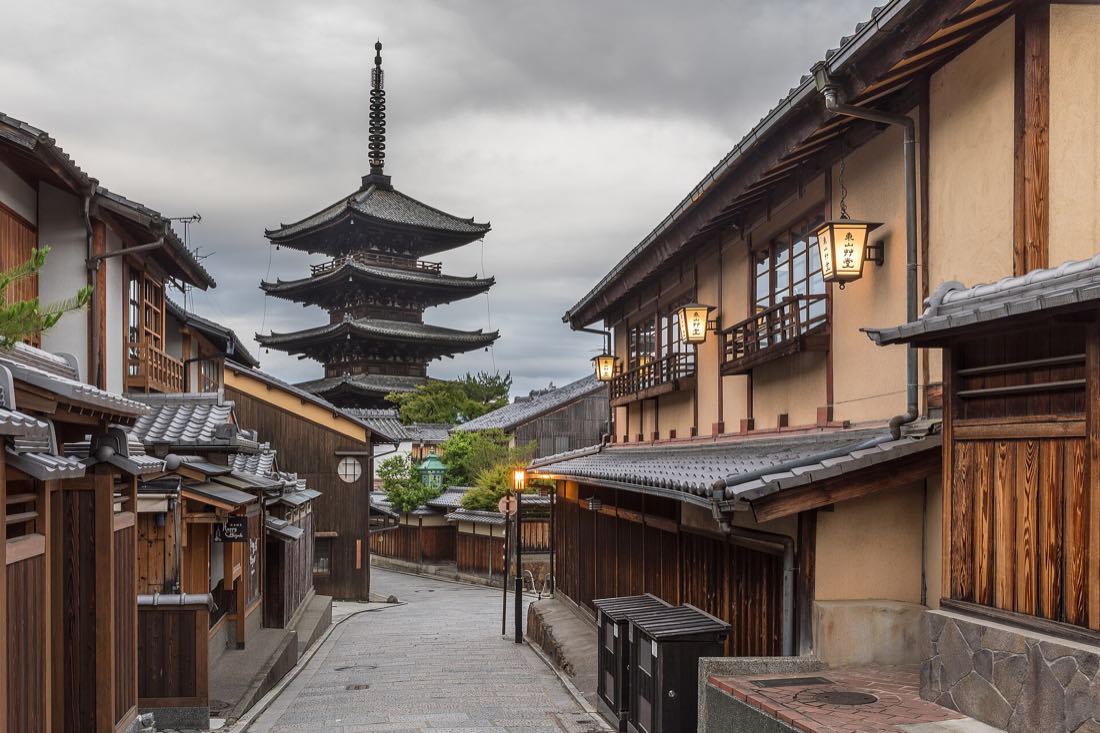
The 6:00 opening is the single most useful fact about Kyoto. A wooden veranda standing thirteen metres over a maple valley, and at dawn you share it with a dozen people instead of a thousand. Walk down through Sannenzaka and Ninenzaka afterwards while the lanes are still empty — the shops do not open until about 10:00, which is exactly the point.
Sanjusangendo — 1,001 statues, no crowd
A 120-metre hall containing 1,001 gilded Kannon figures, each individually carved, plus 28 guardian deities that are genuinely startling up close. Photography is banned inside, so nobody queues for a picture and nobody lingers for one either. It tops more "best thing we did" lists than anything else in Kyoto and it is almost never busy.
Nanzen-ji and the Philosopher's Path
The grounds cost nothing, the enormous Sanmon gate is ¥600 to climb, and a red-brick Meiji aqueduct runs straight through the temple complex, which is a very strange and very good photograph. From there the Philosopher's Path runs two kilometres north to Ginkaku-ji along a canal lined with cherry trees. Half a day, mostly free.
Gion and Hanamikoji at dusk
The one window when geiko and maiko move between engagements is around 17:45. Stay on the main public street: the private alleys off Hanamikoji have been closed to visitors since April 2024 with signposted fines up to ¥10,000, and photographing geiko or maiko without consent has been banned since 2019. Do not follow anyone. Free, and better than any paid show.
Arashiyama — Tenryu-ji, then Okochi Sanso
The bamboo grove is a five-minute corridor and it is a queue after 09:00. What justifies the trip is Tenryu-ji's 700-year-old pond garden (¥500, opens 08:30) and Okochi Sanso (¥1,000 including matcha and a sweet), a film star's hillside garden fifty metres from the mobbed path and reliably near-empty.
Kinkaku-ji, the Golden Pavilion
Be honest about what this is: you cannot go inside, the path is one-way, and forty minutes covers it end to end. It is still the most photographed building in Japan, and gold leaf over a still pond does the job. Go at the 09:00 opening or forget it — by noon the viewing rail is three deep and you cannot step backwards on a one-way path.
The Daitoku-ji subtemples
A walled compound of two dozen subtemples in the northwest, of which three or four open to the public — Ryogen-in, Zuiho-in, Daisen-in — at ¥300–400 apiece. Zen gardens of the quality people fly to Kyoto for, on a Saturday, with nobody in them. Finish at Imamiya-jinja next door, where two shops have been grilling aburi-mochi for a thousand years, about ¥600 a plate.
Nijo Castle and the nightingale floors
The shogun's Kyoto residence, and the only headline sight where the interior is the attraction. Ninomaru Palace's floors were built to squeak underfoot as an alarm system, the painted screens sit in the rooms they were made for, and the whole visit is indoors — which makes it the best wet-weather answer among the big names.
teamLab Biovortex Kyoto
Opened 7 October 2025, eight minutes' walk from Kyoto Station, ¥3,800 adult and ¥1,800 child. It is expensive and it is not remotely traditional, and it is still the strongest rainy-day and with-kids answer in the city. Tickets are sold on the official site only — anything else is a reseller marking it up.
What's overrated in Kyoto
None of these are bad. They are all things that get recommended at the wrong hour, at the wrong price, or for the wrong reason.
Kinkaku-ji at midday. Same ¥500, same forty minutes, but between 11:00 and 15:00 the one-way path jams and you photograph the back of someone's head. Go at the 09:00 opening or after 15:30.
The bamboo grove at noon. It is a five-minute walk between two fences, not a forest. Before 08:30 it is genuinely lovely. After 10:00 it is rickshaws, selfie sticks and no photograph worth keeping. The full verdict is here.
Nishiki Market as a meal. It has drifted heavily toward tourist snacks at tourist prices, tour groups flood it around 11:30, and eating while walking is discouraged — you are meant to eat at the stall. Walk it before 10:00 or after 15:00 and treat it as a walk, not lunch. Honest assessment here.
Queuing at %Arabica. Forty minutes for a good but not extraordinary latte at the Arashiyama and Higashiyama branches. Kyoto has a deep independent coffee scene with no queue at all, three streets back.
Kyoto Tower. Around ¥900 to look at a city with almost no tall buildings in it. The Skyway on the 11th floor of Kyoto Station and the rooftop Sky Garden are free, 200 metres away, and the view is barely different.
Pontocho for dinner value. The alley is one of the most beautiful free walks in Japan. It is also where you pay a premium for a river view and a laminated English menu. Eat one street back, upstairs, or in a basement — then walk Pontocho afterwards.
City buses. Kyoto abolished the ¥700 tourist bus day-pass in 2023–24 specifically to push visitors onto trains. Flat fare is ¥230, the 205 at peak is genuinely unpleasant, and almost everything worth seeing is reachable by subway, JR, the Randen tram, a bike or a fifteen-minute walk.
What's underrated in Kyoto
These are the places that make people say Kyoto was not crowded at all. Most of them are five to twenty minutes from the places that are.
Sanjusangendo, ¥600. The best single hall in the city, and it never queues, because you cannot photograph it.
The Daitoku-ji subtemples, ¥300–400 each, paired with thousand-year-old aburi-mochi at Imamiya-jinja next door, about ¥600 for a plate.
Nanzen-ji — free grounds, a Meiji brick aqueduct running straight through a zen temple, and a ¥600 gate climb with a real view.
Tenryu-ji, ¥500, whose pond garden is the thing Arashiyama visitors most often say they should have given more time to.
Okochi Sanso, ¥1,000 including matcha — repeatedly called the best ¥1,000 in Arashiyama, and fifty metres from the crowd.
Kennin-ji, ¥800. Kyoto's oldest zen temple sits at the bottom of Hanamikoji in Gion and stays quiet. Twin dragons across the ceiling, and photography is permitted, which is rare.
Higashi and Nishi Honganji, free. Two of the largest wooden structures in the world, ten minutes from Kyoto Station, usually near-empty, with coils of rope woven from human hair on display — donated by women during the reconstruction.
To-ji, ¥500, home to Japan's tallest wooden pagoda, plus the Kobo-san flea market on the 21st of every month.
Heian Shrine's garden, ¥600. The grounds are free and unremarkable; the garden behind is one of the best in the city and almost nobody pays to go in.
Shoren-in, ¥600 — camphor trees, a quiet pond garden and tatami you can actually sit on, five minutes from a Gion that is heaving.
Takaragaike Park, free, at the north end of the Karasuma subway line: wild deer, a lake, and essentially zero tourists.
The Fushimi sake district at Chushojima — canals, warehouses, around 40 breweries, and the Gekkeikan museum for ¥600 including a tasting.
Otagi Nenbutsu-ji, ¥500, at the far north end of Sagano: 1,200 moss-covered rakan statues carved by amateurs in the 1980s, every one different and most of them funny.
Ishibei-koji, free — a short stone lane behind Kodai-ji widely called the most beautiful street in Kyoto, and not on the coach route. All of these get a full write-up on the temples-nobody-visits page.
The two things worth paying a guide for
You do not need a tour to see any of the sights above. Temple gates take cash at the door and never sell out — a tour is worth paying for because of the guiding and the hour, not to skip a queue that does not exist. What you can buy is the early hour with company, and someone who can tell you what you are looking at.
Things to do in Kyoto FAQ
Where would you go in Kyoto if you only had about a day?
Kiyomizu-dera at its 6:00 opening (¥500), down through Sannenzaka and Ninenzaka while they are empty, Kennin-ji at 10:00 (¥800), lunch and a rest downtown, Sanjusangendo at 16:00 (¥600), then Hanamikoji at 17:45. That is one district, no buses and about ¥1,900 in entry fees. The full version is on the one-day page.
We haven't planned anything yet — what are the essentials?
Three things, in this order: a bed inside Kyoto rather than Osaka, an alarm set for 6:00 on two mornings, and one district per day. Do Fushimi Inari at dawn on one of those mornings and Kiyomizu-dera at 6:00 on the other. Everything else can be decided over breakfast — no temple in Kyoto sells out, and they all take cash at the gate.
Is 2 days in Kyoto enough?
It is enough for the headline sights if you accept losing a district. Three full days is the honest minimum and four to five is comfortable. On two days do Southern Higashiyama on day one and Arashiyama plus the northwest on day two, and drop the southern rail axis. What you lose is not a sight, it is slack — and slack is what makes Kyoto pleasant.
What should I skip in Kyoto?
Kyoto Tower (~¥900, and the station Skyway is free), the hop-on-hop-off bus (the sights are not on one sensible loop), and any paid "skip the line" temple ticket, because no such line exists. Also skip Kinkaku-ji and the bamboo grove between 11:00 and 15:00 — not the places, the hours.
What is the single best thing to do in Kyoto?
Fushimi Inari before 07:00. It is free, open 24 hours, and five minutes and ¥150 from Kyoto Station on the JR Nara Line, and at that hour you can walk ten minutes under the torii without seeing another person. Nothing else in the city scores that well on cost, access and payoff at the same time.
How much do Kyoto temple entry fees add up to?
Around ¥4,000 per person over three days at a normal pace of two to three paid sights a day. Most temples run ¥500–800; the outliers are Nijo Castle at ¥1,300 with the palace and Okochi Sanso at ¥1,000 including matcha. Several of the best — Fushimi Inari, Nanzen-ji's grounds, the Honganji temples — cost nothing at all.
Do I need to book anything in advance for Kyoto?
Almost nothing. The genuine exceptions are the Nintendo Museum (a lottery about three months out), teamLab Biovortex (official site, timed entry), the imperial villas Katsura and Shugakuin, Saiho-ji, and hotels for cherry blossom or late November, which need six to nine months. Everything else is walk-up.